AI & Automation
AI Automation and Enterprise AI Development
Ixvara builds AI workflow automation, agents, document intelligence, enterprise search, and private AI around real workflows, with explicit data, cost, permission, and action boundaries. We do not add AI because a project needs an AI story. We use it when it produces a better result than conventional software or automation.
AI Automation Capabilities
- Extract information from documents
- Classify and route requests
- Retrieve approved knowledge
- Summarize evidence
- Correlate information across systems
- Draft content or proposed changes
- Recommend next steps
- Operate tools under defined controls
- Coordinate multi-step workflows
- Evaluate outcomes
- Provide employee-facing assistance
- Run locally where appropriate
When a deterministic workflow is better than an AI agent, we use the deterministic workflow.
Model Selection and Deployment
We use the model that fits the job. Some workloads need a frontier cloud model. Some need a smaller specialized model. Some need local inference. Some do not need a model at all.
We design around accuracy, privacy, latency, cost, permissions, resilience, and the consequence of being wrong.
Open-Weight Models
Models with open weights, such as the Llama, Mistral, Qwen, and Gemma families, can run on your infrastructure: on IXBox, on edge compute, or in your own cloud. That is what makes local-only policies, predictable inference costs, and restricted-environment operation possible.
Closed-Weight and Frontier Models
Hosted frontier models bring the strongest reasoning for workloads whose data is allowed to travel. We integrate them through their APIs, under your keys and your data-handling terms, and route work to them by policy rather than by default.
Model Optimization
Getting the accuracy you need at a cost you can live with is engineering, not luck: quantization for local models, right-sizing the model per task, prompt and context optimization, caching, batching, and routing so the expensive model only runs when it earns it. We measure cost per unit of work before and after.
Questions buyers ask us
Which models does Ixvara use?
The model fits the job. Some workloads use a frontier cloud model, some a smaller specialized model, some local inference, and some no model at all. Model and provider selection is part of the architecture design for each workload, not a fixed allegiance.
Is customer data used to train models?
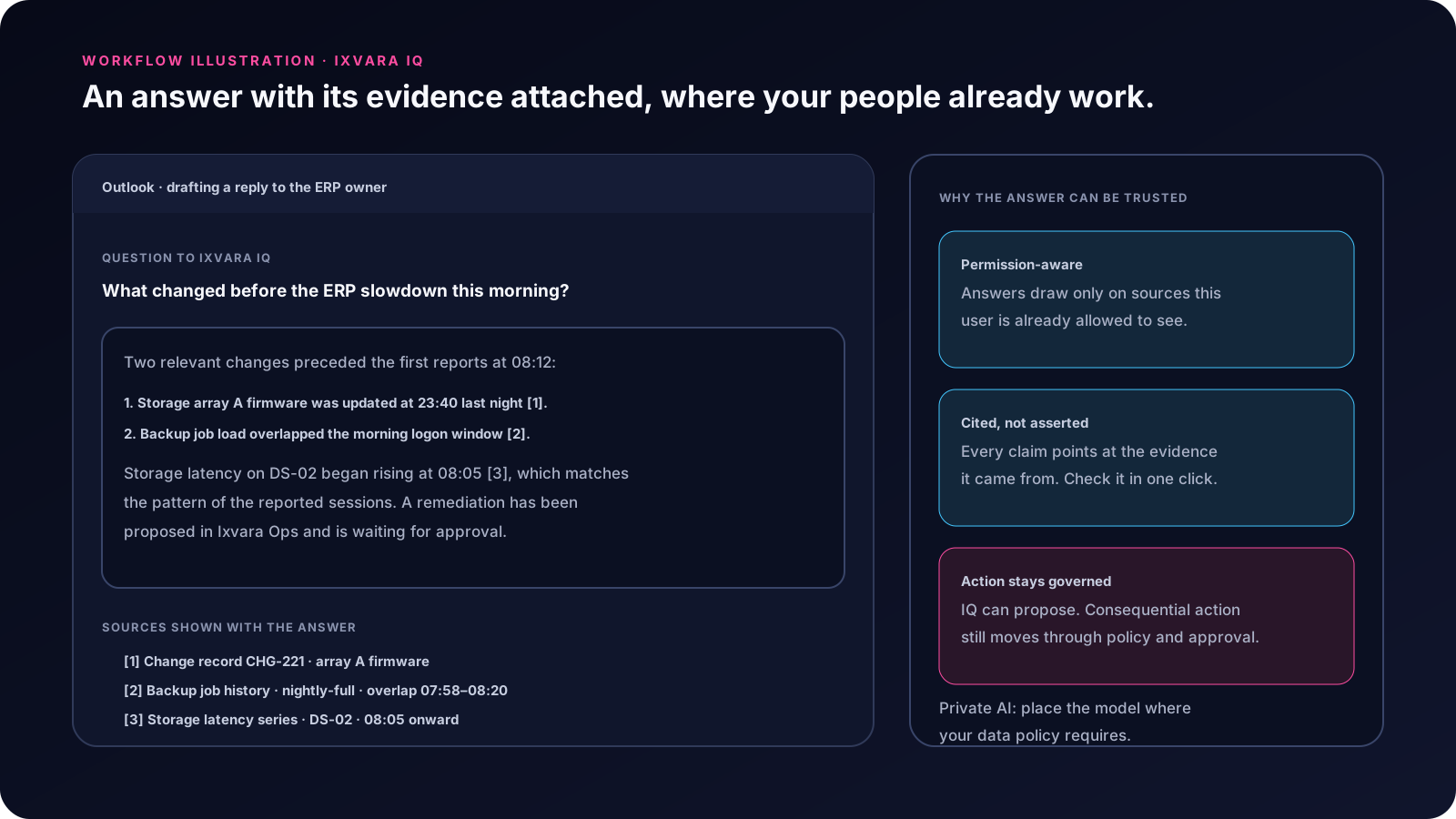
No. Where systems ground answers in your content, they use retrieval against permission-checked sources at question time, not model training on your data.
Can AI run without sending data to a hosted model?
Yes, when deployed and validated for local operation. Under a local-only policy, prompts, retrieved context, and execution stay inside the defined boundary, with no silent fallback to a cloud model.
How is untrusted content handled?
Retrieved documents and user-supplied content are treated as data, not instructions. Consequential action still requires the policy and approval path regardless of what a document says.
What can an agent actually do?
Only the tools it has been given, inside the identity, role, policy, and approval boundaries configured for it. Actions are logged with attribution, and supported outcomes are verified rather than assumed.
How do we know it works before we commit?
Every AI engagement defines evaluation criteria up front: accuracy against representative data, cost per unit of work, and the consequence of being wrong. The pilot exists to produce that evidence.
Starting engagement
AI Pilot
Pick one workflow where success can be measured. We build enough of the real architecture to test accuracy, usability, control, cost, and production fit before expanding the scope.
What you get
- One bounded use case with real representative data
- Model and automation architecture
- Evaluation criteria
- Human and control boundaries
- Cost profile
- Production recommendation
Discuss an AI Automation Project
Bring the workflow, the data it runs on, and what better would look like. We will tell you whether AI belongs in it.